Strict environmental regulations and rapid technological progress are transforming the transport and logistics industry. Battery-electric trucks (BEVs) are at the forefront of this change, offering companies sustainable, cost-efficient, and future-proof solutions.
The numbers speak for themselves: between 2023 and 2025, battery-electric truck registrations in the EU rose by 68 percent. In the second half of 2025, electric trucks reached a market share of 5.6 percent in Europe for the first time — driven primarily by the EU fleet emissions standards that became binding in 2025. Markets in the Netherlands and Scandinavia are growing particularly fast, while Germany still has room to catch up.
Types of battery-electric trucks (according to EU classification)
Light electric trucks (Class N1): These vehicles, with a gross vehicle weight of up to 3.5 tonnes, are ideal for urban delivery and regional distribution. With a range of up to 200 km and the ability to charge using existing infrastructure, they offer a cost-effective solution for short distances.
Medium electric trucks (Class N2): With a gross vehicle weight of up to 12 tonnes, such as the Scania 25 P BEV, these trucks are often used in regional distribution. They offer a greater range of up to 300 km and are ideal for daily operations over medium distances, supported by adaptable charging infrastructure.
Heavy electric trucks (Class N3): With a gross vehicle weight of up to 40 tonnes, such as the Volvo FH Aero Electric or the Scania 45 R BEV, these trucks face greater challenges in heavy-duty and long-haul transport. They require larger battery capacities, which can extend their range to up to 600 km. Technological advancements and the development of more powerful fast-charging stations make these trucks a practical option for long-haul transport.
Electric trucks 2026: comparison of leading models
| Manufacturer |
Model |
Range |
Battery capacity |
Charging time |
Primary application |
| Mercedes-Benz |
eActros 300 |
up to 300 km |
336 kWh |
1:15 h (160 kW DC) |
Distribution |
|
eActros 400 |
up to 400 km |
448 kWh |
1:40 h (160 kW DC) |
Regional |
|
eActros 600 |
up to 500 km |
621 kWh |
60 min (CCS), 30 min (MCS) |
Long-haul |
| Volvo |
FL Electric |
up to 450 km |
up to 565 kWh |
~2:30 h |
Urban/Regional |
|
FE Electric |
up to 275 km |
up to 375 kWh |
~2:30 h |
Regional heavy cargo |
|
FH Aero Electric |
up to 600 km |
up to 780 kWh (new generation, from Q2 2026) |
MCS fast charging (new generation) |
Long-haul |
|
FH Electric |
up to 300 km |
360–780 kWh (4–6 packs) |
~40 min (DC) |
Long-haul, heavy transport |
|
FM Electric |
up to 300 km |
up to 540 kWh |
~2:30 h |
Volume logistics |
| Scania |
25 P / 25 L BEV |
up to 250 km |
up to 300 kWh |
~1–1.5 h (150 kW) |
Urban |
|
45 R BEV |
up to 530 km (at 40 t) |
up to 728 kWh |
~85 min (375 kW DC); MCS up to 1,000 kW available |
Long-haul, heavy transport |
| Renault Trucks |
E-Tech T |
up to 600 km |
up to 575 kWh |
~1:50 h (150 kW) |
Long-haul |
|
E-Tech D |
up to 560 km |
up to 575 kWh |
~1:50 h (150 kW) |
Regional |
|
E-Tech D Wide |
up to 315 km |
up to 575 kWh |
~1:35 h (150 kW) |
Urban |
| MAN |
eTGX |
up to 570 km |
up to 480 kWh (up to 6 packs) |
~2 h (150 kW DC); ~30 min with MCS (from Q2 2026) |
Long-haul, ADR-compliant |
|
eTGS |
up to 300 km |
up to 480 kWh (up to 6 packs) |
~1.5 h (150 kW DC); MCS option from Q2 2026 |
Regional heavy transport, construction logistics |
| DAF |
XB Electric |
up to 280 km |
up to 282 kWh |
150 kW DC |
Urban distribution (12–19 t) |
|
XD Electric |
up to 500 km |
210–525 kWh (LFP) |
150 or 325 kW DC |
Urban/regional distribution |
|
XF Electric |
up to 500 km |
210–525 kWh (LFP) |
150 or 325 kW DC |
Long-haul freight |
|
XG / XG+ Electric |
over 500 km |
210–525 kWh (LFP) |
150 or 325 kW DC |
International long-haul |
Mercedes-Benz eActros
Models: The Mercedes-Benz eActros is available in several variants tailored to different applications and requirements. The main models include the eActros 300, eActros 400 and the newer eActros 600, which is specially designed for long-distance transportation.
Range:
- eActros 300: up to 300 km
- eActros 400: up to 400 km
- eActros 600: up to 500 km
Battery capacity:
- eActros 300: 336 kWh (with 3 packs)
- eActros 400: 448 kWh (with 4 packs)
- eActros 600: 621 kWh (3 packs)
Charging times:
- eActros 300: approx. 1h 15 min (20% to 80%), max. charging power: 160 kW
- eActros 400: approx. 1h 40 min (20% to 80%), max. charging power: 160 kW
- eActros 600: approx. 60 minutes (20% to 80% — Combined Charging System), approx. 30 minutes (20% to 80% — Megawatt Charging System)
Use cases:
- eActros 300: suitable for urban and regional distribution
- eActros 400: suitable for medium distances
- eActros 600: specifically designed for long-haul transport and suitable for long distances and demanding transport tasks

Volvo electric trucks
Models: Volvo offers a wide range of electric trucks, many of which are well-suited for transport logistics.
Range:
Battery capacity:
- Volvo FL Electric: 280 kWh to 565 kWh (3–6 battery packs)
- Volvo FE Electric: 280 kWh to 375 kWh (3–4 battery packs)
- Volvo FH Aero Electric: up to 780 kWh (new generation with e-axle, up to 8 battery packs)
- Volvo FH Electric: 360 kWh to 780 kWh (4–6 battery packs)
- Volvo FM Electric: 180 kWh to 540 kWh (2–6 battery packs)
Charging times:
- Volvo FL Electric: up to 2.3 hours (depending on the number of battery packs)
- Volvo FE Electric: up to 2.3 hours (depending on the number of battery packs)
- Volvo FH Aero Electric: MCS fast charging (new generation, from Q2 2026)
- Volvo FH Electric: 40 minutes (DC fast charging)
- Volvo FM Electric: 9.5 hours (43 kW), 2.5 hours (250 kW)
Use cases:
- Volvo FL Electric: Ideal for urban deliveries and regional distribution, especially in areas with strict environmental regulations.
- Volvo FE Electric: Suitable for more demanding tasks such as transporting heavy loads in urban and regional environments.
- Volvo FH Aero Electric: Long-haul and long-distance transport — new generation available for order from Q2 2026, maximum gross combination weight 48 tonnes.
- Volvo FH Electric: For transporting large volumes of goods and long-haul freight.
- Volvo FM Electric: Ideal for high-volume food deliveries, container transport, and urban deliveries.

Scania electric trucks
Models: Scania offers several battery-electric truck models, including the Scania 25 P BEV, Scania 25 L BEV, and Scania 45 R BEV, each designed for different use cases.
Range:
- Scania 25 P and Scania 25 L: up to 250 km
- Scania 45 R: up to 530 km (at 40 tonnes gross weight)
Battery capacity:
- Scania 25 P and Scania 25 L: up to 300 kWh
- Scania 45 R: up to 728 kWh (standard configuration)
Charging times:
- Scania 25 P and Scania 25 L: approx. 1–1.5 hours (at 150 kW DC)
- Scania 45 R: approx. 85 minutes (at 375 kW DC); MCS up to 1,000 kW available
Use cases:
- Scania 25 P and Scania 25 L: optimal for urban transport
- Scania 45 R: long-haul and heavy transport up to 40 tonnes

Renault electric trucks
Models: Renault Trucks offers a broad range of battery-powered trucks. While the Renault E-Tech C is designed for urban construction transport, the E-Tech T, E-Tech D, and E-Tech D Wide are ideal for regional and urban freight operations.
Range:
Battery capacity:
- E-Tech T, E-Tech D and E-Tech D Wide: 200 kWh to 575 kWh, configurable to specific requirements
Charging times:
- E-Tech T: 31 minutes (at 375 kW)
- E-Tech D: 1 hour 50 minutes (at 150 kW)
- E-Tech D Wide: 1 hour 35 minutes (at 150 kW)
Use cases:
- E-Tech T: regional distribution
- E-Tech D: urban and suburban transport
- E-Tech D Wide: local transport

MAN electric trucks
Models: The MAN eTGX and MAN eTGS are the heavy-duty models in MAN's battery-electric product range. For medium-duty distribution, MAN also offers the eTGL as a 12-tonne truck.
Range:
Battery capacity:
- MAN eTGX: up to 480 kWh (up to 6 battery packs)
- MAN eTGS: up to 480 kWh (up to 6 battery packs)
Charging times:
- MAN eTGX: approx. 2 hours (at 150 kW DC); approx. 30 minutes with MCS (10–90%, up to 750 kW) — MCS option available from Q2 2026
- MAN eTGS: approx. 1.5 hours (at 150 kW DC); MCS option also available from Q2 2026
Use cases:
- MAN eTGX: long-haul transport, also suitable for hazardous goods (ADR-compliant)
- MAN eTGS: regional heavy transport, construction logistics

DAF electric trucks
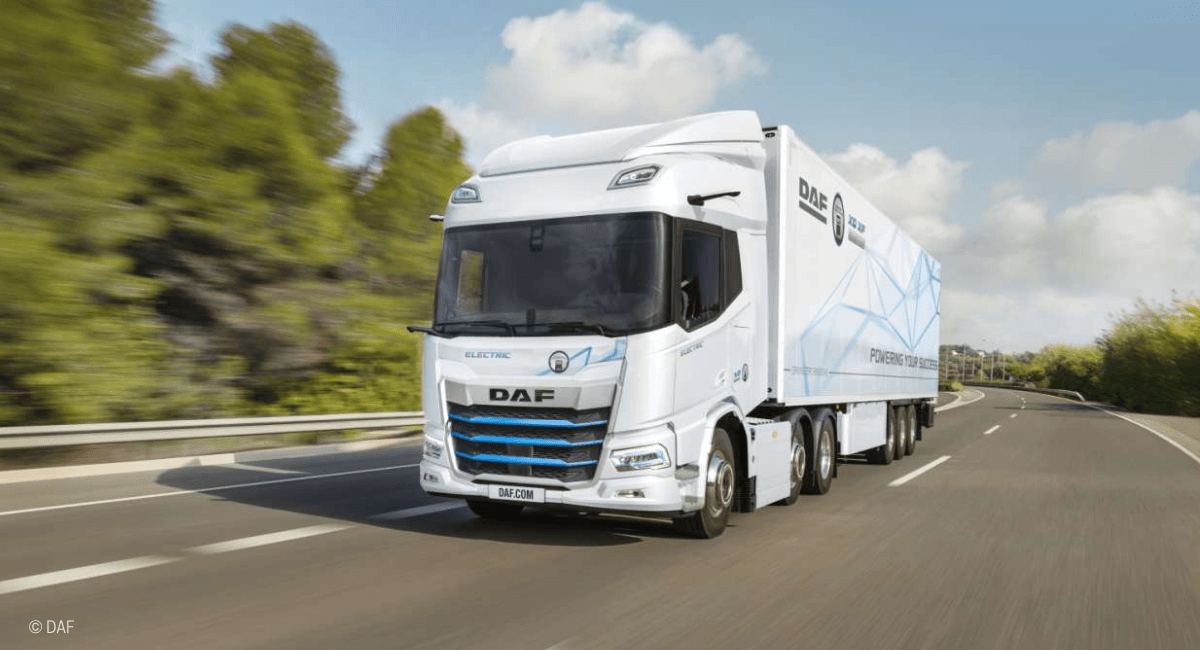
Models: DAF offers a complete electric truck range with the XB Electric, XD Electric, XF Electric, and the XG and XG+ Electric — covering every application from urban distribution to international long-haul. The DAF XD and XF Electric were awarded the International Truck of the Year 2026. For construction and off-road applications in zero-emission zones, DAF also offers the rugged XDC and XFC Electric variants — both with over 500 km range and an optional electric power take-off (E-PTO).
Range:
- DAF XB Electric: up to 280 km
- DAF XD Electric: up to 500 km
- DAF XF Electric: up to 500 km
- DAF XG / XG+ Electric: over 500 km
Battery capacity:
- DAF XB Electric: up to 282 kWh
- DAF XD, XF, XG / XG+ Electric: 210, 315, 420 or 525 kWh (LFP technology, modular configuration)
Charging times:
- DAF XB Electric: up to 150 kW DC
- DAF XD, XF, XG / XG+ Electric: 150 or 325 kW DC
Use cases:
- DAF XB Electric: urban distribution for 12 to 19-tonne vehicles
- DAF XD Electric: urban and regional distribution
- DAF XF Electric: long-haul freight
- DAF XG / XG+ Electric: international long-haul with the most spacious cabs on the market
Advantages of electric trucks in transport logistics
Despite the initial challenges of building charging infrastructure and higher upfront costs, electric trucks are proving to be economically advantageous in the long run. Projections by the International Council on Clean Transportation (ICCT) indicate that battery electric trucks will be the most cost-effective option for decarbonisation by 2030, further accelerating their adoption and acceptance.
Environmental benefits: Electric trucks make a significant contribution to reducing CO₂ emissions, helping companies meet their climate targets. In addition, their quiet engines reduce noise pollution in urban areas, which is particularly beneficial for night-time operations and inner-city deliveries. This not only improves the quality of life for city residents, but also reduces the environmental impact in urban areas.
Economic benefits: Although the upfront purchase price of battery-powered trucks is currently higher than that of diesel models, this is offset in the long run by lower operating costs and reduced maintenance requirements. Companies can also benefit from financial incentives such as toll exemptions and subsidy programmes at federal and state level, such as the subsidy programme in North Rhine-Westphalia, which specifically supports the transition to electric trucks. The use of electric trucks also strengthens a company's image and provides a competitive advantage in a market increasingly focused on sustainability.
Technological advantages: In urban applications, light and medium-duty battery electric trucks already achieve comparable total cost of ownership (TCO) to their diesel counterparts, as lower operating costs offset the higher purchase price. For heavy-duty trucks in long-haul applications, TCO parity with diesel vehicles is now within reach — as battery prices fall and charging infrastructure grows, the economics continue to improve (source: ICCT). Ongoing advances in battery technology and charging processes are leading to longer ranges and shorter charging times, further improving the efficiency and flexibility of electric truck operations.
Advanced fleet management systems such as those provided by IO-Dynamics enable precise control and monitoring of electric truck fleets, maximising energy efficiency and minimising maintenance costs. These technological advances make the integration of electric trucks into transport logistics even more attractive and economically viable.
Key considerations for choosing the right vehicle
Choosing the right vehicle is critical in transport logistics, especially when transitioning to electric trucks. Several factors must be carefully considered to ensure that this step is both economically and sustainably successful in the long run:
- Maximum payload: The payload capacity of an electric truck is a key factor in determining the efficiency and capacity of your logistics processes. Make sure that the electric truck you choose can meet your payload requirements without compromising range or other performance parameters.
- Gross vehicle weight: The total weight of the vehicle is critical because it affects both operating costs and regulatory compliance. This includes tolls and road restrictions related to vehicle weight. When choosing an electric truck, make sure the gross vehicle weight — including battery and load — meets regulatory requirements while still fulfilling your operational needs.
- Range and charging capabilities: The range of an electric truck is often the deciding factor in vehicle selection. Make sure the range is sufficient to cover your typical routes without frequent charging stops. The availability and speed of charging infrastructure along your routes is also important. Make sure the truck is compatible with different charging systems to maximise operational flexibility.
- Available chassis space: Chassis space on an electric truck is critical for integrating additional equipment, such as specialised bodies or cargo restraints. Make sure there is enough space to accommodate all operational requirements without compromising vehicle performance. This allows the truck to be seamlessly adapted to your specific transport needs.
- Integration with existing logistics processes: A smooth transition to electric mobility requires the seamless integration of the electric truck into your existing logistics and fleet management processes. Consider how well the vehicle integrates with your IT systems and operations. This includes maintenance requirements, driver and technician training, and route planning adjustments. Thoughtful integration minimises downtime and maximises efficiency.
Considering these factors will help ensure a sustainable and efficient investment.
Looking ahead: electric trucks paving the way for a sustainable future in transport logistics
The numbers speak for themselves: between 2023 and 2025, electric truck registrations in the EU rose by 68 percent. In the second half of 2025, electric trucks reached a market share of 5.6 percent in Europe — driven by EU fleet emissions standards that became binding in 2025. Companies deploying electric trucks now are positioning themselves as leaders in a changing industry, benefiting not only from environmental gains but also from long-term cost savings.
With our intelligent charging and energy management software, we support you in successfully navigating the transition to electric mobility. We guide and advise you on your journey and provide a management platform that helps you meet today's market requirements while remaining competitive and environmentally responsible in the long term. Learn more about our intelligent charging solutions for transport and logistics fleets.


